

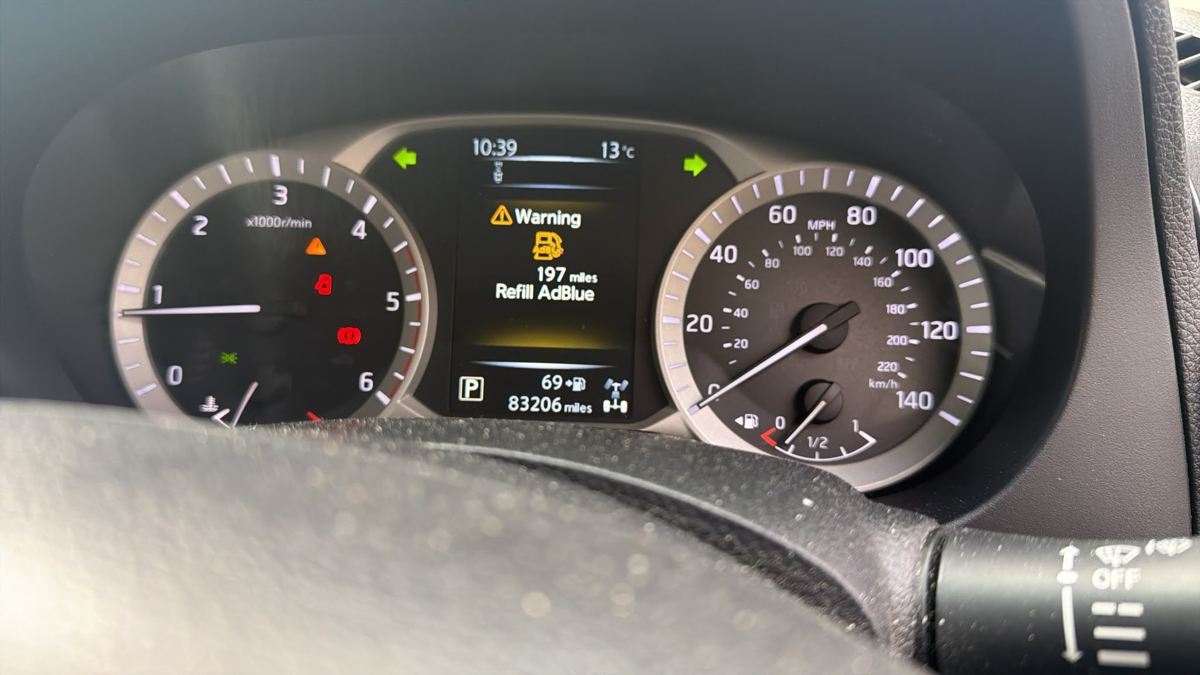

Short answer: you can only reset an AdBlue warning yourself if the tank genuinely ran low: refill with AdBlue from a sealed container and the message usually clears once the ignition has been on or the vehicle has been driven for a while. If the warning survives a correct refill, a fault is logged, and clearing codes or disconnecting the battery only hides it for a drive or two.
The lasting fix is a proper diagnosis. Our mobile diagnostic visit is £185 (included if you go ahead with the full fix on the day), and our AdBlue software service starts from £249 with a lifetime warranty, at your home, work or depot across London, Surrey, Sussex and Kent.
Search “AdBlue reset” and you’ll find dozens of make-by-make tricks: hold this button, pull that fuse, plug in a cheap code reader. The reason so many people search for one, and then search again a week later, is that most AdBlue warnings aren’t a level problem at all. This guide explains which warnings a reset can genuinely clear, which it can’t, and what to do before a countdown reaches zero.
Can you reset an AdBlue warning yourself?
Only if the warning was caused by a genuinely low or empty tank. Refill with fresh AdBlue from a sealed container, and on most vehicles the message clears after the ignition has been on or the vehicle has been driven for a while. There is no owner button that cancels a logged AdBlue fault, on any make we work on.
That distinction, “low level” versus “logged fault”, is the whole story. A low-level message is the car asking for fluid. A fault message means the engine control unit (ECU) has run one of its emissions self-tests and the result was wrong: a NOx sensor reading out of range, dosing pressure too low, a tank heater drawing no current, fluid quality out of spec. Fluid can’t fix any of those.
Two situations trip people up most: a warning that won’t clear after a refill, and one that appears with the tank already full. Both have their own guides.
If you’re not sure which you have, read the exact wording on the dash. Our AdBlue warning light guide lists the common messages by manufacturer, and the photo above shows the kind of refill message where topping up is the right first step.
Why does the AdBlue warning come back after a reset?
Because a reset wipes the record of the fault, not the fault itself. Within a drive cycle or two the ECU reruns the same self-test, finds the same weak pump, failed heater or drifting sensor, and logs the code again. If a countdown had started, it carries on from where it was rather than starting afresh.
A typical sequence on a van: the owner tops up, someone clears the code with a reader, the dash goes quiet for a day or two, then the warning and countdown reappear. Our Ford Transit page explains why a Transit AdBlue reset never holds, and the same logic applies to other makes, because every Euro 6 diesel reruns these self-tests.
There’s a second cost. Clearing codes without fixing the cause can also wipe the freeze-frame data (engine speed, temperatures and dosing status at the moment the fault set) that a technician would use to find the failed part. Our AdBlue fault codes guide explains why one code rarely means one part.
Will disconnecting the battery reset the AdBlue countdown?
No. Disconnecting the battery may blank some warnings briefly, but the AdBlue fault and the countdown are held by the engine ECU, and the next self-test relogs them. Owners often try a battery disconnect, a code clear and a top-up in turn before accepting that the counter keeps coming back.
If your dash is already counting down, the more useful step is to note the exact message and the miles remaining, and get the fault diagnosed while you still have miles in hand.
Can a cheap code reader reset AdBlue?
A code reader can clear a stored code, but the fault is still there and the code typically returns within a drive cycle or two. Generic scanners also can’t see much of the manufacturer-specific data behind AdBlue faults, such as dosing pressure against the commanded value or tank heater current, which is what pins down the failed part.

That’s why the diagnostic tools matter. On our visits we use manufacturer-level equipment to read every stored code with its freeze-frame data and then test the system live: both NOx sensors with the engine running, dosing pressure, heater draw, fluid quality and the injector, wiring and connectors. The readings tell us which code is the cause and which are knock-on symptoms.
When does a professional reset actually work?
A reset holds when the cause has genuinely been dealt with: the tank was empty and has been refilled with good fluid, a corroded connector has been cleaned, or stale fluid has been drained. After a repair, some systems also need control modules re-initialised so the ECU accepts the change. Our diagnostic visit includes those resets.
Some faults are honestly cheap. We don’t fit parts, so we have nothing to sell you: if the readings show stale fluid or a corroded connector, we tell you, and any garage can sort it. A reset after that kind of fix is a real fix, and the warning stays off because the self-test now passes.
What if a reset won’t hold and the countdown is running?
Book a diagnosis before the counter reaches zero. The engine won’t cut out mid-journey, but once the countdown ends the vehicle typically won’t restart after you switch off. The starting figure varies by make and model, and a busy van can use it up within days.
If it has already reached zero, don’t arrange recovery to a garage first. We work on locked-out vehicles where they’re parked; our AdBlue no-start page and the guide to what to do when the countdown hits zero cover that situation.
Reset, repair or software fix: which do you need?
It depends on what the diagnosis finds. A genuine one-off, such as an empty tank, a connector or stale fluid, needs a simple fix and a reset. A failed sensor, pump or heater needs either replacement parts or our software solution. Repeat failures, or a parts bill bigger than the vehicle justifies, usually point to the software route.
For context, genuine replacement NOx sensors are expensive, and most vehicles carry two. On many vans the heater, pump and sensors are sealed into the tank unit, so one failed element can mean a complete assembly. We don’t fit parts: we show you what has failed and explain both routes before any work begins; see our AdBlue repair page.
Where a permanent software fix is the right answer, our AdBlue delete service starts from £249, with vehicle and use eligibility checked first; it is not lawful for a vehicle used on public roads to have its emissions equipment removed or disabled, and our guide to whether an AdBlue delete is legal in the UK sets out where it is used legitimately. ECU unlocking, where required, is quoted separately before work starts. The fix is permanent unless you ask us to reverse it.
Where can I get AdBlue diagnosed without going to a garage?
We’re a mobile service, so the vehicle doesn’t need to move. We cover London, Surrey, Sussex and Kent from our base near Gatwick, attending homes, workplaces and depots 8am to 8pm, 7 days a week. Send your registration and postcode and we’ll confirm whether we can attend.
Coverage by area:
- London: all of London, with no extra charge for London jobs, including Croydon, Bromley, Sutton and Kingston.
- Surrey: including Redhill, Reigate, Guildford, Woking and Epsom.
- Sussex: including Crawley, Gatwick, Horsham, East Grinstead, Brighton and Worthing.
- Kent: including Sevenoaks, Maidstone and Tunbridge Wells.
The full list is on our areas covered page.
Warning still on after a reset? Get a fixed quote with your registration and the exact dash message, call 0207 046 1823, or WhatsApp 07403 415966.
AdBlue reset: frequently asked questions
If the tank was genuinely low, refilling with AdBlue from a sealed container is the reset: the message usually clears after the ignition has been on or the vehicle driven for a while. If it stays on, the ECU has logged a fault, and no button or fuse will clear it for good.
Not permanently. Clearing the code may pause the warning briefly, but if a countdown has started it carries on, and the fault is relogged when the ECU retests the system. A countdown stops for good when the cause is fixed.
Our diagnostic visit is £185 and includes fault-code and live-data checks, control module resets and written findings. It’s included if you go ahead with the full fix on the day. Our AdBlue software service starts from £249, diagnostics included.
Usually because the level was never the problem. Crystallised fluid, a failed NOx or level sensor, a blocked injector or a tired pump will all keep the warning on however full the tank is, and the ECU’s internal counters can hold it on after a refill.
Yes. We’re mobile across London, Surrey, Sussex and Kent, 8am to 8pm, 7 days a week. We work at your home, workplace, depot or a safe roadside spot, so there’s no garage visit or recovery to arrange.
About the author. Written by Mobile AdBlue Fix, a mobile AdBlue, NOx and SCR specialist based near Gatwick and covering London, Surrey, Sussex and Kent. We diagnose with manufacturer-level equipment at your vehicle before recommending anything, price the options up front, and back our software work with a lifetime warranty. How the lifetime warranty works.
Related Articles

U029D and U029E Fault Codes: Lost Communication With a NOx Sensor
U029D means the engine control unit has lost contact with NOx sensor A (U029E is sensor B). Why it isn't always the sensor, what both codes…
Read article
P207F Fault Code: AdBlue Quality Warning Explained
P207F means the engine control unit doesn't trust the AdBlue quality. Why it isn't always bad fluid, the codes it comes with, what to check yourself…
Read article
AdBlue No Start Countdown in Croydon: What to Do
An AdBlue no start countdown in Croydon? Learn what triggers it, why refills don't clear it, and how a mobile ECU fix sorts it at your…
Read article